By Eric Gandler Clifton Park Development Electric – Serving Clifton Park and the Capital Region
A power outage lasting a few seconds may be an inconvenience. An outage lasting several hours can become a serious problem for a business.
Computers shut down. Refrigeration stops. Security systems can be affected. Employees may be unable to work, customers may have to leave, and important equipment can suddenly go offline.
For businesses in Clifton Park, preparing for unexpected power interruptions should be part of any commercial property maintenance plan.
Eric Gandler Development Electric helps businesses evaluate their electrical infrastructure and develop practical solutions for keeping critical systems operating when normal utility power is interrupted.
What Happens to Your Business When the Power Goes Out?
The answer depends heavily on the type of business you operate.
A retail store may lose lighting and point-of-sale systems. A restaurant could face refrigeration and food-storage concerns. An office may lose computers, internet equipment, phones, and security systems. A manufacturing facility could experience an immediate halt in production.
Before considering backup power, businesses should identify which electrical systems are truly critical to continued operations.
These may include:
- Emergency and security lighting
- Refrigerators and freezers
- Computer servers and networking equipment
- Security and access-control systems
- Phone systems
- Critical machinery
- Pumps
- Medical or specialized equipment
- Selected HVAC equipment
Understanding these priorities makes it easier to develop an appropriate backup power strategy.
Backup Power Doesn’t Necessarily Mean Powering Everything
One of the most important parts of backup power planning is determining what actually needs to remain operational.
Keeping an entire commercial facility running during an outage may require substantial generating capacity. In many cases, however, a business only needs to maintain certain critical loads.
An experienced commercial electrician can evaluate your electrical system and help determine which circuits and equipment should receive priority.
This can result in a backup system that is both more practical and more cost-effective.
Commercial Standby Generators
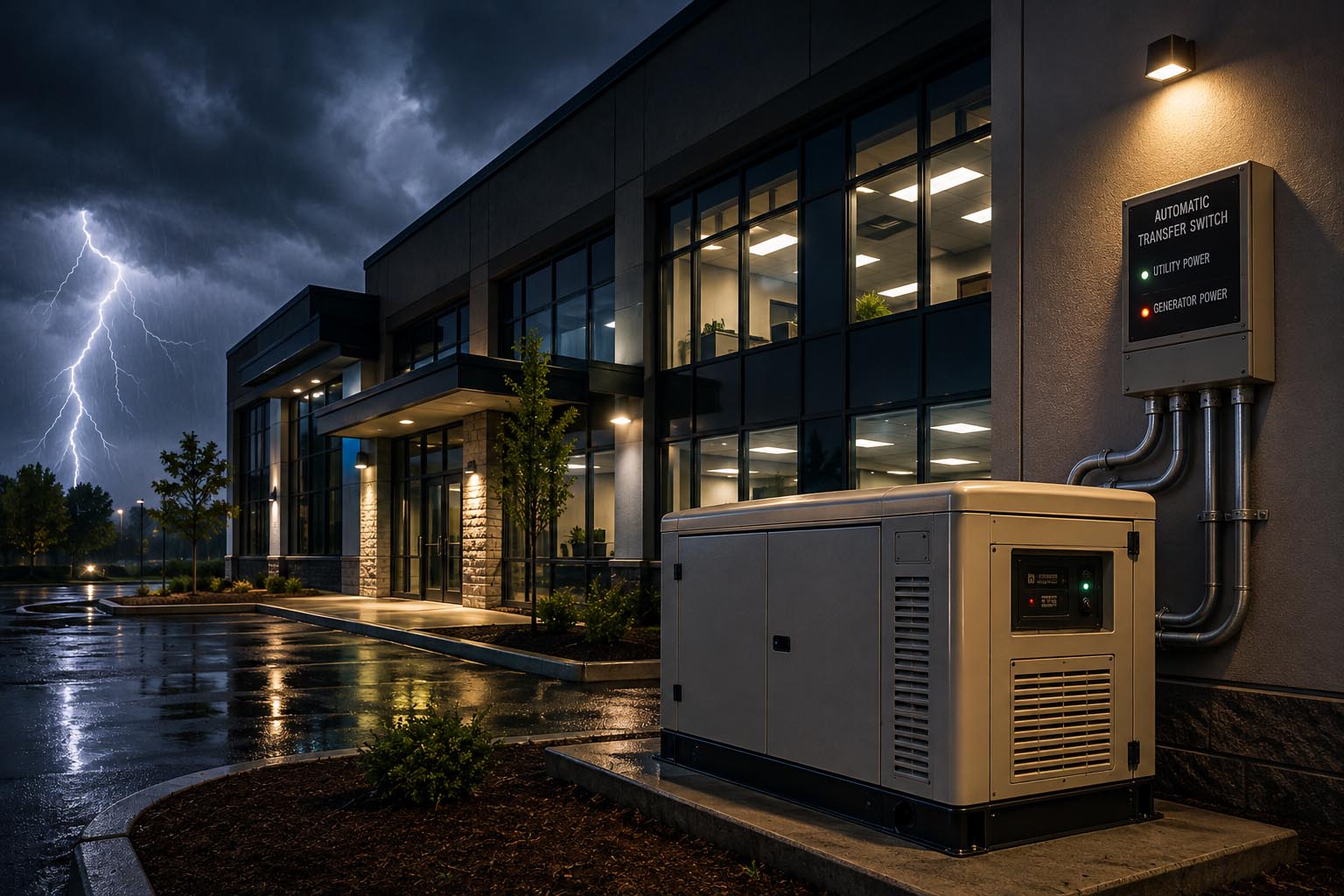
A standby generator can automatically provide electricity when utility power is lost.
Depending on the design of the system, a generator may support selected critical circuits or a much larger portion of the facility.
Commercial generator installations require careful consideration of:
- Electrical load requirements
- Generator capacity
- Transfer equipment
- Fuel availability
- Installation location
- Electrical code requirements
- Future power needs
Proper sizing is particularly important. A generator that is too small may not reliably support the required equipment, while unnecessarily oversizing a system can increase project costs.
What Is an Automatic Transfer Switch?
An automatic transfer switch, commonly called an ATS, is an important part of many standby generator systems.
When utility power fails, the transfer switch detects the interruption and transfers the selected electrical load to the backup generator. When normal utility power returns, the system transfers the building back to utility power.
This allows backup power to activate without someone manually reconnecting electrical equipment during an outage.
Battery Backup and UPS Systems
Generators aren’t the only form of backup power.
Uninterruptible power supply systems can provide immediate short-term power to sensitive electronics such as:
- Servers
- Network equipment
- Computers
- Security systems
- Communications equipment
A UPS can help bridge the gap between the loss of utility power and generator startup. It may also allow equipment to be shut down properly during longer outages.
For some businesses, combining UPS equipment with a standby generator provides a more comprehensive solution.
Protect Equipment When Power Returns
The outage itself isn’t the only concern.
Electrical disturbances can occur when utility power is interrupted or restored. Sensitive electronic equipment may be vulnerable to voltage fluctuations and power surges.
Commercial surge protection can add another layer of protection for equipment such as computers, HVAC controls, security systems, refrigeration controls, and other electronics.
Backup power and surge protection address different problems, which is why both may be appropriate for facilities with critical equipment.
Develop an Electrical Emergency Plan
Technology is only part of outage preparation.
Businesses should also know what employees are expected to do when power is lost.
An electrical outage plan might identify:
- Which equipment should remain operational
- Which equipment should be shut down
- Where electrical disconnects are located
- Who is responsible for contacting service providers
- How critical data and equipment are protected
- How operations will continue during an extended outage
Planning these steps in advance can eliminate confusion when an outage actually occurs.
Don’t Forget About Routine Testing
Installing backup equipment is only the beginning.
Generators, transfer switches, batteries, and related electrical equipment should be inspected and tested according to applicable manufacturer recommendations and maintenance requirements.
Discovering that a backup system isn’t working during an actual outage is far too late.
Preventative maintenance helps ensure the system is ready when your business needs it.
Is Your Existing Electrical System Ready for Backup Power?
Older commercial buildings weren’t necessarily designed with modern backup power requirements in mind.
Before installing a generator or other backup system, an electrical evaluation may reveal the need for:
- Panel modifications
- New dedicated circuits
- Transfer equipment
- Service upgrades
- Updated wiring
- Changes to electrical distribution
This is another reason professional planning should happen before purchasing backup equipment.
Which Clifton Park Businesses Should Consider Backup Power?
Backup power can be beneficial for many commercial operations, but it becomes especially important when an outage could cause significant financial loss or safety concerns.
Businesses that may want to evaluate their options include restaurants, medical offices, warehouses, manufacturing facilities, offices with critical computer systems, retail stores, property management companies, and facilities containing refrigeration or specialized equipment.
The right solution depends on the consequences your particular business would face during an extended outage.
Commercial Backup Power Planning in Clifton Park
You can’t control when the utility power goes out, but you can control how prepared your business is when it happens.
A well-planned backup power system can help protect critical equipment, reduce downtime, maintain essential operations, and allow your business to recover more quickly from an unexpected interruption.
Eric Gandler Development Electric provides commercial electrical services throughout Clifton Park and the Capital Region, including electrical system evaluations, generator electrical infrastructure, transfer equipment, surge protection, electrical upgrades, and preventative maintenance.
If your business has never evaluated what would happen during an extended power outage, now is a good time to start. Eric Gandler Clifton Park Development Electric can assess your existing electrical system and help determine which backup power solutions make sense for your facility.